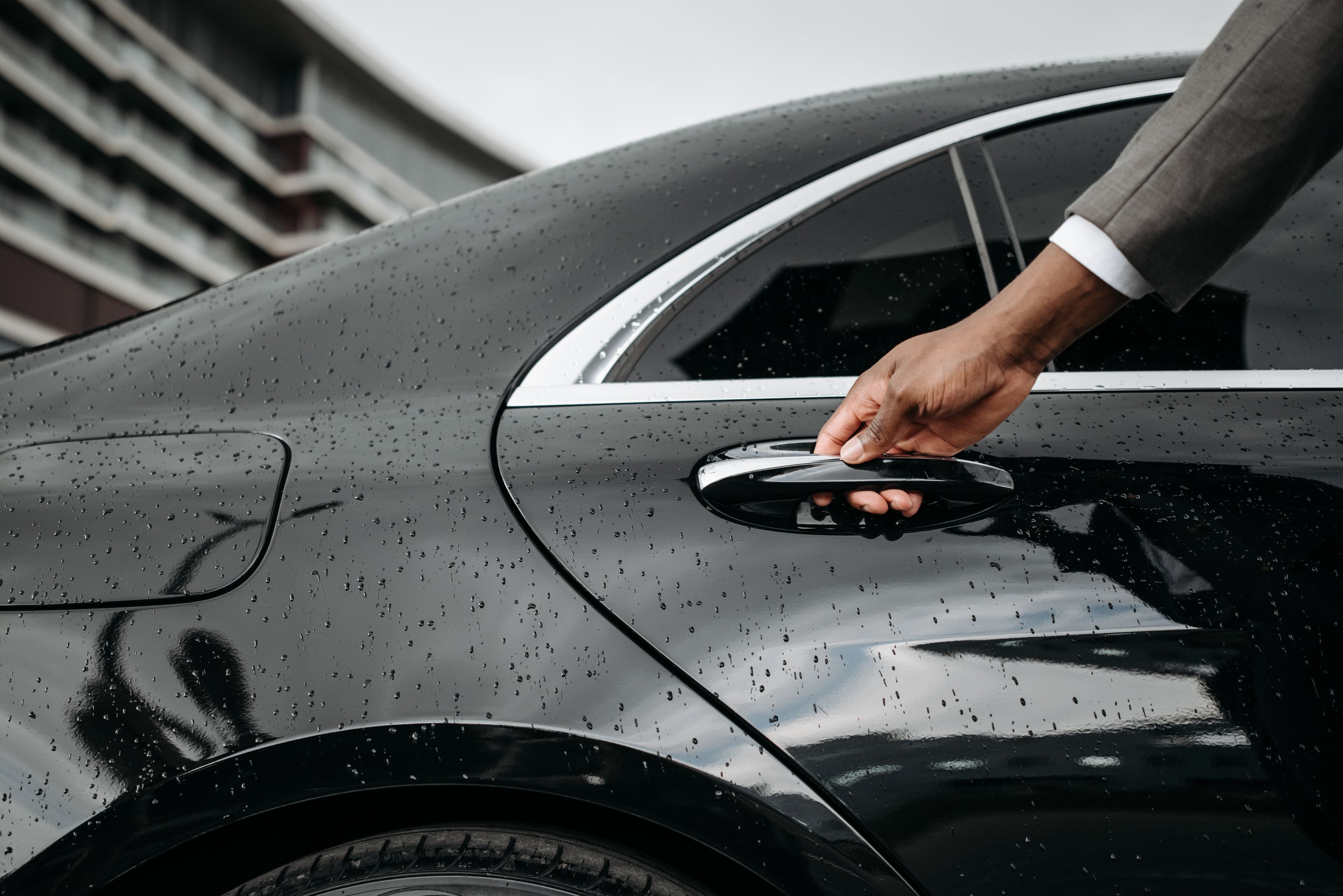





Passengers rarely notice good driving. What they notice is the absence of certain sensations: no sudden braking, no lurching into gaps, no lifting against the seatbelt at roundabouts, no moment of holding the door handle. Those absences are not luck or a soft suspension. They are the visible result of a method that has been taught to professional drivers for decades.
Defensive driving is that method. It is less about skill in an emergency than about arranging the journey so emergencies do not arise, which is a considerably harder thing to do and a far duller thing to watch. It is also the single clearest technical difference between a professional chauffeur and a competent private motorist.
The principles behind it
The foundation is space. A defensive driver keeps a following distance that allows a full reaction with room to spare, positions the car where the view ahead is longest, and treats every gap as something to be entered deliberately rather than seized. Space converts a sudden event into a manageable one, and almost every other principle in the method exists to protect it.
The second foundation is anticipation. Rather than responding to what a vehicle is doing, a defensive driver reads what it is about to do - a wheel turning slightly, a head checking a mirror, a bus indicating three cars ahead - and adjusts early enough that no adjustment is felt inside. Reading the road two or three moves ahead is the habit that separates trained drivers from experienced ones.
- Generous following distance, extended in poor conditions
- Road position chosen for the longest possible view ahead
- Early, gentle braking rather than late, firm braking
- Speed matched to conditions rather than to the limit
- Constant scanning of mirrors, junctions and pavements
- Assuming other road users may not have seen you
How it feels from the rear seat
The passenger experience is one of continuity. Acceleration and braking are progressive, steering inputs are single and smooth rather than corrected mid-corner, and gaps in traffic are used calmly rather than exploited. Coffee stays in the cup, a laptop stays usable, and a passenger reading or sleeping stays undisturbed for the length of the journey.
It also feels slower than it is, which is the part clients most often misjudge. A defensively driven car on a congested route usually arrives at the same time as an aggressively driven one, because progress in traffic is governed by the traffic rather than by the driver. What differs is how the occupants feel on arrival and how much of the journey they were able to use.

Not the same as advanced or evasive driving
Advanced driving is a broader discipline covering the whole craft, including making brisk progress safely, and is assessed by qualifications available to any motorist in the United Kingdom. Defensive driving is one strand within it, focused specifically on hazard avoidance. The two overlap heavily, and most professional training programmes teach elements of both.
Evasive or protective driving is something else entirely. It belongs to the security field, involves manoeuvres intended to remove a vehicle from a threat, and is taught to close protection operatives rather than to chauffeurs. Nothing in defensive driving involves speed, aggression or dramatic technique; it is the opposite discipline, and it is the one that carries passengers comfortably.