


Seeing a city from a private car is a particular kind of day, and it works best when everybody understands what it is. It is not a tour with commentary, and it is not a transfer with stops attached. It is a day where the pace is yours, the weather stops being a problem, and somebody else is responsible for the entirely tedious question of where to park.
What follows describes such a day from planning to the last drop-off. It is specific about the limits, because this is the service where expectations most often drift. Knowing in advance what your chauffeur will and will not do makes the day better rather than smaller, and it means the parts you did want are arranged properly.
Telling us what you actually want to see
The most useful opening message is not a list of landmarks. It is a sentence about who is coming, how long you have, and what you have already seen. A first visit with two teenagers, a returning guest who has done the obvious things, and a couple with one free afternoon before a flight all want completely different days from the same city.
Tell us about walking too. Some visitors want to be out of the car constantly and use it only to move between districts. Others want a slower day with a few long stops and a warm cabin in between. Neither is wrong, but they produce different routes, and guessing wastes the first hour of the day discovering which one you are.
How the route is put together
A good sightseeing route flows geographically rather than following a list. London in particular punishes criss-crossing: the same three miles driven four times in different directions will eat an afternoon. So we group things by district and by light, taking the riverside early while it is quiet, the parks and museums in the middle of the day, and somewhere that looks well in late afternoon at the end.
The plan is a proposal rather than a timetable. Most guests reorder it during the day, skip something that turned out not to interest them and stay twice as long somewhere unexpected. That is the entire point of travelling this way, and your chauffeur will adjust without any suggestion that the plan mattered. The proposal exists to save you the first hour of the day, not to hold you to anything.
- One district at a time, so the same streets are not crossed repeatedly
- The riverside and the ceremonial quarter early, while they are quiet
- Museums and parks through the middle of the day
- Somewhere that photographs well kept for late afternoon
- Lunch placed where the car can wait rather than where the map suggests
- One deliberately empty slot for whatever turns out to interest you
Stopping, pausing and photographs
There is a practical distinction worth knowing. Setting down and picking up is possible almost anywhere legal. Pausing with the car stationary while you photograph something from the window is possible in far fewer places than visitors expect, because a great many of the best views in British cities sit on red routes, bus lanes or junctions where stopping is not permitted at all.
Your chauffeur knows where the genuine pause points are, and he will use them. Where a view can only be photographed on foot, he will set you down, tell you where he will be, and collect you when you are ready. What he will not do is stop somewhere that risks a penalty or blocks traffic, however brief the shot would be.
Coats, bags, umbrellas and shopping stay in the car all day. For most guests that turns out to be the single biggest practical improvement over doing the same day independently, particularly in a British spring. Nothing goes into a cloakroom queue, nothing is left behind in a cafe, and nothing has to be carried up the steps of a museum.
What your chauffeur is, and is not
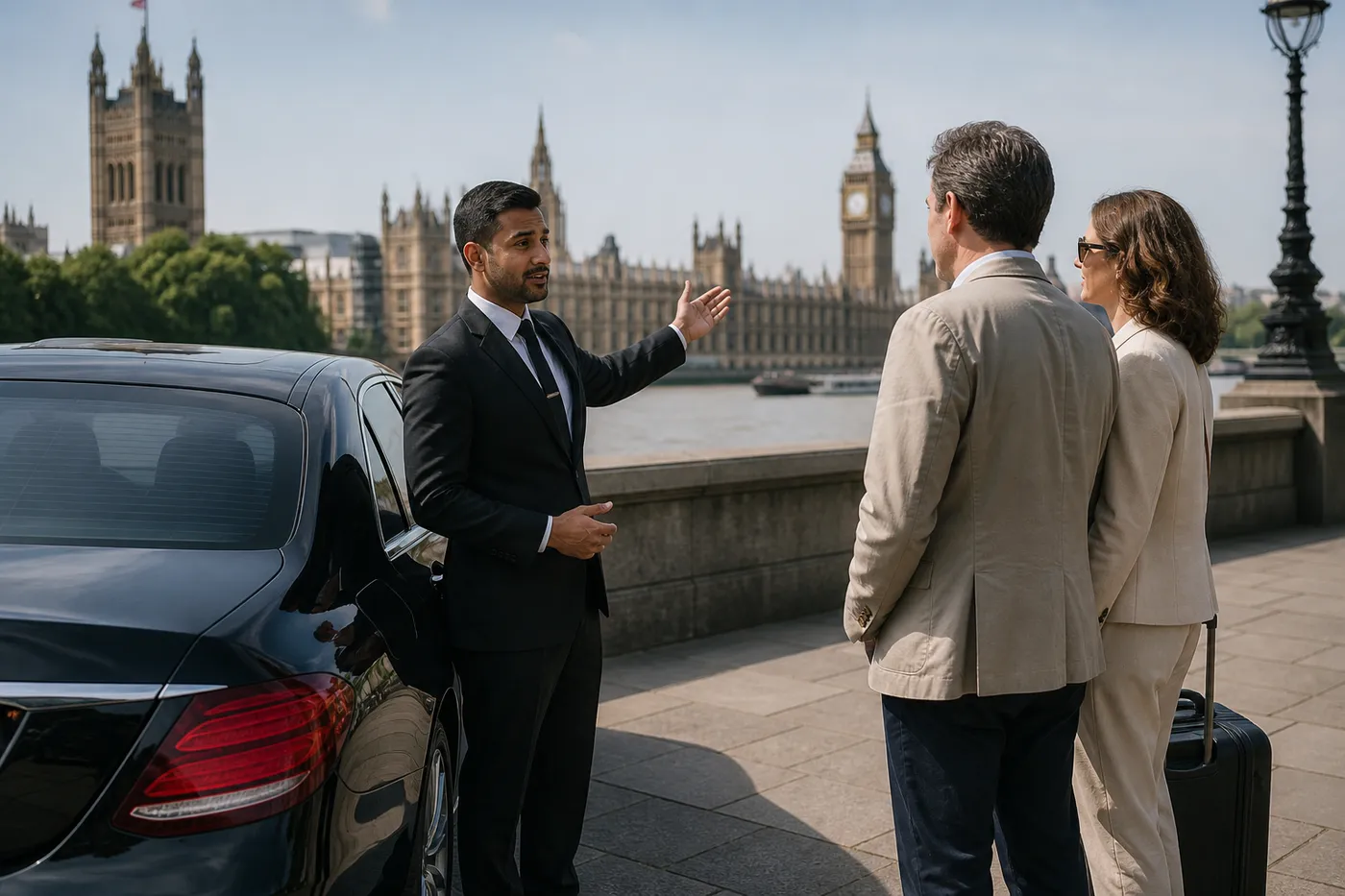
Your chauffeur is a professional driver with strong local knowledge. He is not a licensed or registered tour guide, and we will not describe him as one. He will happily point out what you are passing, answer questions, tell you which of two queues moves faster and recommend somewhere to eat that is not a tourist trap. That is knowledge and courtesy rather than qualification.
If you want proper commentary, historical depth or guided access inside museums, monuments and palaces, engage a registered guide and we will drive both of you very happily. That combination is genuinely excellent and quite common: the guide handles the content, we handle the ground, and neither is trying to do the other's job badly. Most professional guides prefer working that way as well.
Tickets, timed entry and queues
Admission tickets are arranged by you rather than by us. We provide the car and the chauffeur only, and we do not book, hold or supply entry to any attraction. Most major sites now use timed entry slots, and those are far easier to secure yourself in advance than to obtain on the day. Some sell out weeks ahead in high season.
What we will do is plan the driving around your slots so you are not sitting in traffic while an entry window passes. Tell us the times you hold and the route is built to protect them. If two slots are genuinely incompatible given the traffic between them, we will say so while there is still time to change one.
- Book timed entry slots yourself, well ahead, for the major attractions
- Send us the slot times and we will build the driving around them
- Allow more time between two ticketed sites than the map suggests
- Expect a walk from the set-down point at pedestrianised sites
- Keep one flexible slot in the day for whatever turns out to interest you
- Tell us about mobility needs, which change which sites are practical
Weather, children and the honest edit
Rain changes a sightseeing day rather than ending it, which is the strongest argument for doing it this way in Britain. An indoor site moves up the order, a walk gets shortened, and everybody dries out in a warm cabin between stops instead of standing under an awning deciding what to do. That is a modest advantage on paper and a considerable one in February.
With young children, the honest advice is usually a shorter day than parents first plan. A busy morning, an early lunch and one afternoon stop works better than a full day that ends with everybody tired and nobody enjoying the last two hours. We will suggest the shorter version rather than sell the longer one, and it tends to be remembered more fondly.