





The phrase turns up most often in vehicle listings and in enquiries from clients who have seen one in a film. As a specification item it is real and well defined, but the range of cars that carry it in ordinary chauffeur service is narrow enough that asking for one substantially changes what can be allocated to your date.
This entry treats the term as it appears on a spec sheet rather than as a historical curiosity: the forms it takes, why the fitting has become rare, what to request when privacy rather than the panel itself is the actual requirement, and the several other words used for the same piece of glass.
The forms the fitting takes
Not every divider does the same job, and the differences matter when you are asking for one. Some are structural and permanent; some retract at the touch of a switch; some do not move at all but change from clear to opaque electrically. A listing that says only partition tells you almost nothing about which of these you would get.
- A fixed bulkhead, solid and permanent, common on converted vehicles
- A manually operated glass panel that slides or lifts into place
- A powered glass divider raised and lowered on a switch
- Electrochromic glass that turns opaque without moving at all
- An intercom or handset for speaking to the chauffeur when raised
- A rear-view arrangement compensating for the obstructed mirror
Why the fitting has become rare
Manufacturers of executive saloons largely abandoned the idea, and the engineering that replaced it is the reason. Insulation, sealing and seat design between them put the rear occupant far enough from the front of the car that a physical wall adds little, while costing cabin space, adding weight and complicating the airbag and mirror layout considerably.
The vehicles that retain a divider tend to do so because the separation is part of what the car is for rather than a convenience: ceremonial vehicles, stretched conversions built for a particular kind of hire, and protected vehicles where the bulkhead serves a structural purpose. That is a small and specialised group.

What to ask for instead
Almost everybody who requests a partition wants an outcome rather than a component: not to be overheard, not to be seen, or simply to be left alone. Describing the outcome gets you a better result than naming the part, because the outcome can be met on a great many vehicles while the part cannot.
In practice that means saying you have confidential calls to make, or that you would rather not be visible from the pavement, or that you want no conversation at all for the duration. Each of those is noted on the booking and passed to the chauffeur before the day, and each is achievable in a well-specified saloon without any glass moving anywhere.
Other names for the same thing
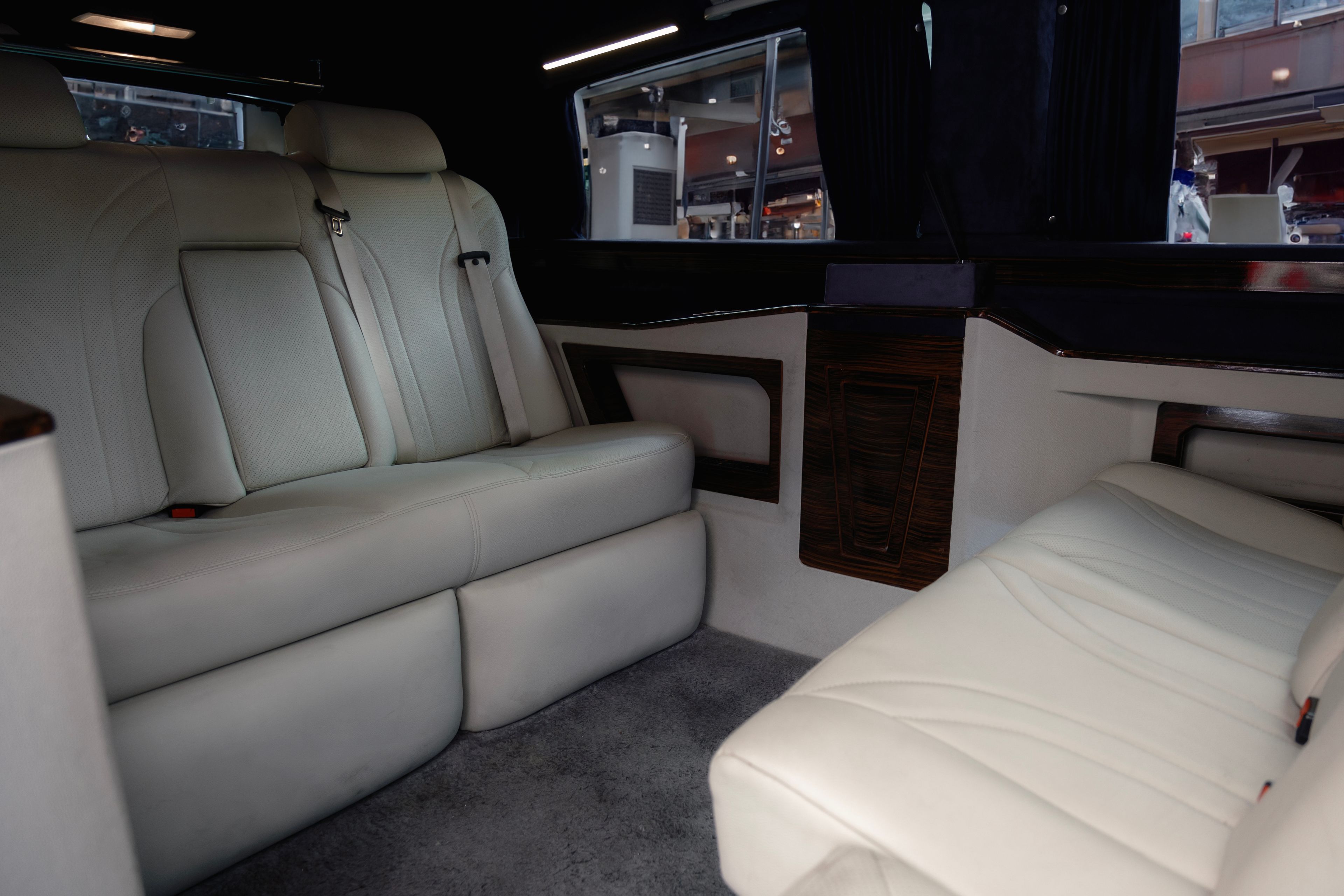
Divider, bulkhead, glass screen and limousine partition all describe the same broad fitting, and hire listings use them interchangeably with no consistency whatever. If a specific arrangement matters to you, ask what the vehicle actually has rather than accepting the word on the page. A photograph of the actual interior settles the question faster than any amount of correspondence about terminology.
Two related terms are worth keeping apart. A protective screen of the kind fitted in some licensed taxis is a safety barrier serving an entirely different purpose. And a partition should never be assumed to arrive simply because a vehicle is described as a limousine, since that word covers a wide range of quite different cars.