



Biggin Hill is unusual among British business aviation airfields because it sits inside a London borough while behaving, on the road at least, entirely like Kent. The postcode promises a quick run and the topography does not deliver one. Anyone planning a transfer here benefits from understanding the last five miles rather more than the first twenty, because that is where the estimates tend to come apart.
What follows is written for passengers arranging the car rather than the flight. Luxury Chauffeurs is an independent chauffeur company; we have no relationship with the airfield, the terminal operators or any handling agent, and we work to whatever access those parties permit on the day. The value we add is the road plan, the vehicle choice and a willingness to say plainly when a timing is optimistic.
An airfield inside Greater London
The site occupies high ground in the borough of Bromley, on the southern lip of the capital. For anyone working in the City, at Canary Wharf or across south-east London, that position is the whole argument: no motorway crawl to Bedfordshire, no hour lost before the aircraft is even reached. For residents of Kent, Surrey and the North Downs villages it is frequently the nearest sensible option by a wide margin.
Being inside London also means the capital's emissions and charging regimes apply to the approach in a way they do not at the out-of-town airfields. That is our problem rather than yours, since the applicable charges are folded into the written quotation, but it is worth knowing why the run from Essex or Hertfordshire is priced and routed differently from the equivalent distance elsewhere.
The climb, and why it is slow
Most approaches leave the M25 in the south-east or come up off the A21 and then climb through the Downs on roads that were laid out for villages rather than for airport traffic. They are good roads and pleasant to drive, but they are not quick. A single agricultural vehicle, a set of temporary lights or a wet Friday evening will each add time that no amount of local knowledge recovers.
From the City or Canary Wharf the run is dominated by whichever river crossing the traffic permits. From the West End it is longer still, because you are crossing the whole of south London before the climb even begins. We treat the descent and climb as a fixed cost in the plan and flex the London section around it, rather than assuming a clear road and apologising afterwards.
- M25 in the south-east, then local roads climbing through the North Downs
- A21 northbound from Tunbridge Wells, Sevenoaks and the Kent Weald
- River crossings govern anything starting in the City or Docklands
- The West End adds a full crossing of south London before the climb
- Temporary lights and farm traffic are routine on the final approach
- Wet or icy conditions affect the hill far more than the motorway

Weather on high ground
The airfield's elevation gives it a microclimate that occasionally differs from the city below. Low cloud, hill fog and winter ice can affect operations here when central London looks entirely benign from a window in Mayfair. That is a matter for your operator to judge, not us, but it has a ground consequence worth planning for: departures from Biggin Hill are diverted or retimed slightly more often than at a flat, coastal field.
In practice this means keeping the collection arrangement loose on marginal days and keeping the chauffeur in the loop. If your flight moves to another airfield, the road journey changes completely rather than slightly, and the earlier we hear the better the vehicle and the driver we can put on the new plan. A message the evening before a doubtful morning is time well spent.
Hours, and what they mean for the car
Movements at Biggin Hill operate within locally agreed hours, with restrictions around the night period that your operator will know precisely. We deliberately do not publish specific times, because they are subject to change and because getting them wrong in print helps nobody. The effect on ground transport, though, is consistent: departures cluster into the morning and evening shoulders, which are exactly the hours when the approach roads are busiest.
The consequence is that a seven o'clock departure and a seven o'clock arrival are entirely different road problems even though the airfield is the same. Early collections from central London run against a thin traffic flow and are comfortable. Evening arrivals coincide with the commuter tide across south London, and we build the return leg around that rather than pretending the map is telling the truth.
Meeting points and handler rules
Where a car waits and whether a chauffeur may come into the building are decisions for the operator of the terminal you are using, and they are not uniform across the site. Some arrangements have the chauffeur meet passengers inside; others have the vehicle held in a designated area with a short walk out. Both are entirely normal and neither is something we can override or guarantee in advance.
So we ask your operator or handler what applies for your flight and then confirm it back to you in writing before the day. Your chauffeur follows that instruction rather than improvising at a barrier, which sounds obvious and is the single most common failure at controlled sites. We take no part in security screening, documentation or anything airside; our territory ends where the handler says it does.
Details that help on this route
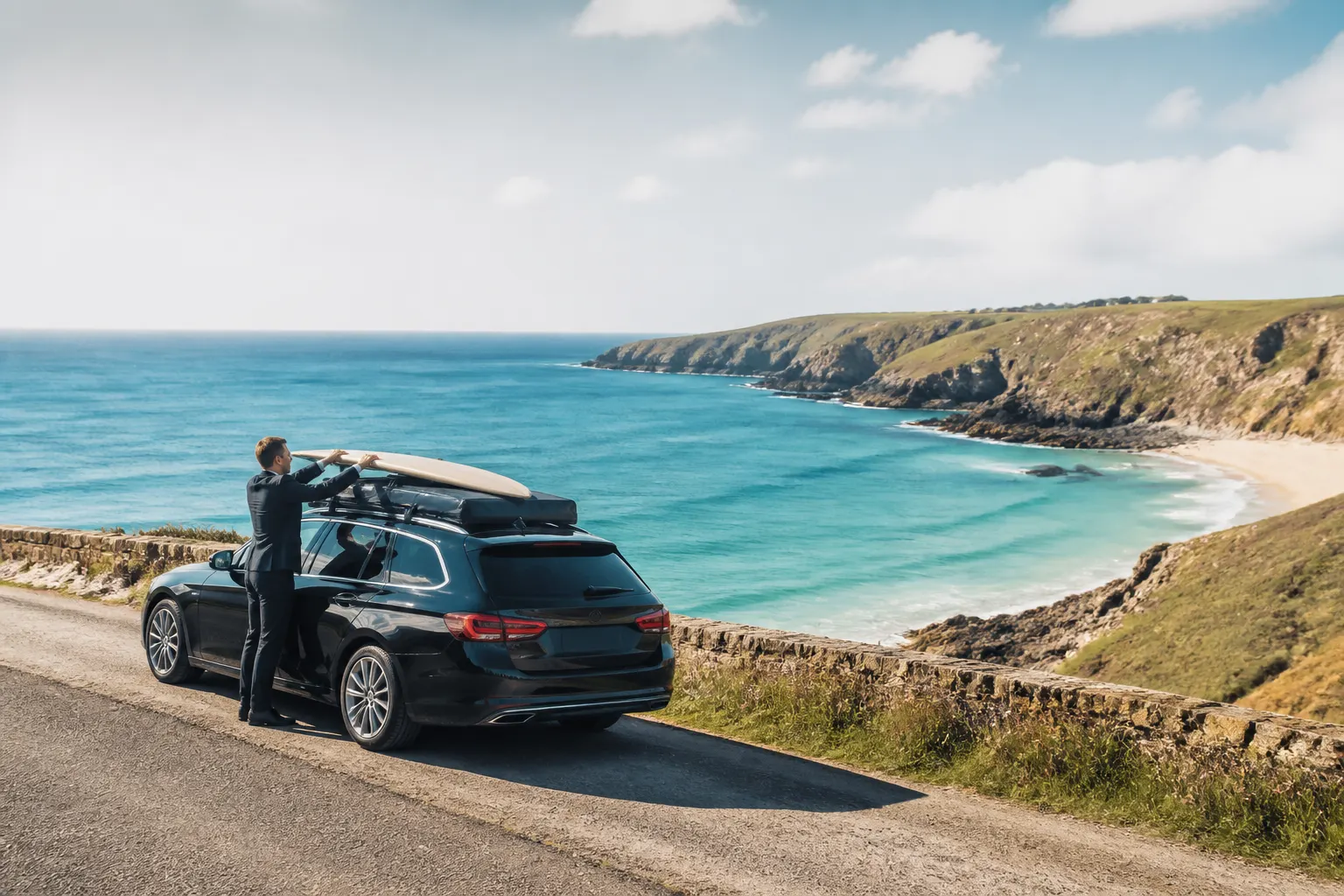
Because the drive has more variance than the distance implies, small pieces of information have outsized value. Knowing that you are coming from a City office rather than a Kensington address changes the route entirely. Knowing that three of the party are joining from a hotel in Sevenoaks changes the vehicle. Knowing that you have skis changes both, and it is far better established a week out than at the kerb.
Send the outline over WhatsApp or by email and we come back with a written quotation covering the car, the timings and the terms; nothing is held until you agree it. Vehicles are drawn from our own fleet and a vetted network of professional chauffeur operators, so a second car for luggage or a crew vehicle on separate timings can sit on the same booking without complication.
- The exact start address, since south London routing changes with it
- Handling agent named by your operator, for the correct entrance
- Whether crew need a separate vehicle on their own timing
- Passenger and bag count, including sports or equipment cases
- Any second collection point on the way to the airfield
- A contact reachable on the day if the slot moves