



Somewhere past about two hours of driving, chauffeur travel changes character. The variables that dominate a city transfer, such as congestion and parking, fade almost to nothing, and a completely different set takes over: how many hours a chauffeur may legally work, where the car ends up at the end of the day, and whether anybody has to sleep somewhere other than home.
This matters because long journeys are the ones where sensible planning makes the largest difference. A trip from Kent to Edinburgh can be arranged in ways that differ enormously in cost while feeling identical from the back seat. What follows explains the mechanics, so that you can describe your journey in a way that produces the better of those arrangements.
Priced in driver hours, not miles
On a motorway run the mileage is genuinely predictable, which makes the fuel and wear component the easy part. The commitment that actually shapes the quotation is the chauffeur's day: the time behind the wheel, the legally required breaks, and the fact that a person who drives to Cornwall in the morning is not available for anything else that afternoon.
Professional driving hours are regulated for good reason, and the rules bite on exactly this kind of work. A journey that looks like a long but manageable day on paper may require a rest period in the middle, or a second chauffeur, or an overnight stay before the return. None of that is discretionary, and the honest way to handle it is to plan for it openly at the enquiry stage.
This is why the total elapsed time of a trip matters more than its length. A four-hour drive with a two-hour wait and a four-hour drive back is a very long working day. The same two drives on consecutive days is a comfortable arrangement. Where your schedule allows the second shape, it is almost always the better one to ask for.
The empty return leg
A one-way journey has two halves, and you only travel in one of them. When a chauffeur delivers you to Newcastle and then drives back to Surrey with nobody in the car, that return is time and fuel spent on your booking even though you never see it. Quotations that ignore this either bury it somewhere or belong to an operator who has not thought it through.
The consequence is worth remembering when you plan. Booking a return with the same operator, on the same day or the next, converts an empty leg into a productive one. So does timing a one-way journey to end near where the car is based, or accepting a chauffeur based nearer the far end. There is often more than one way to arrange the same trip.
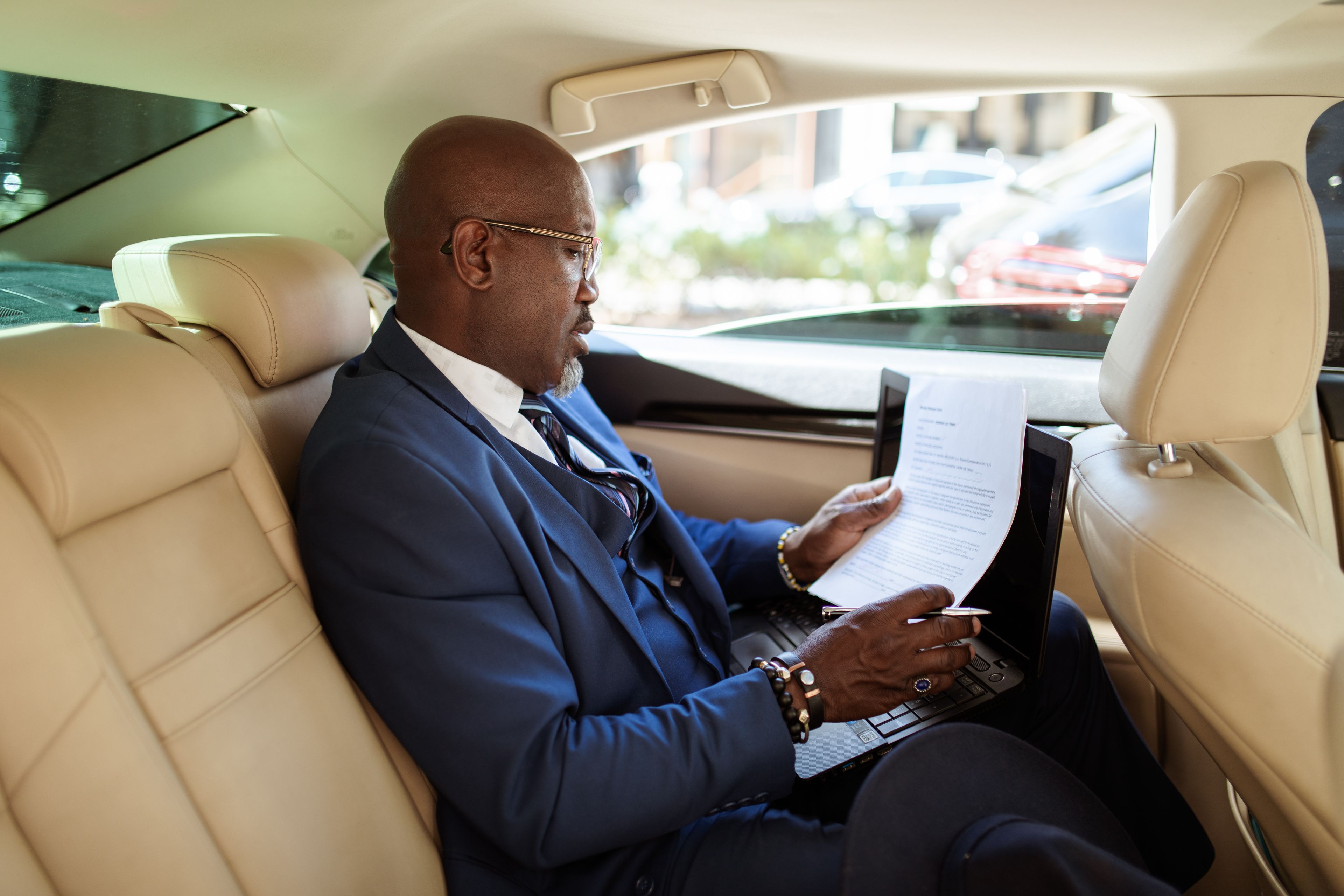
Overnight stays and second chauffeurs
For anything involving a long outbound, a full day at the far end and a long return, an overnight stay for the chauffeur is frequently the sensible answer rather than an indulgence. It removes a punishing double drive, keeps the same person with you for the whole trip, and means the car is on your doorstep in the morning rather than several hours away.
The alternative is a second chauffeur, which suits journeys that must be completed in one continuous stretch. Which of these fits depends entirely on the shape of your trip, and it is one of the first things worth discussing. Both are planned in advance and set out in the written quotation rather than appearing as an afterthought.
- Total driving time in each direction, not just the distance
- How long the car is needed at the far end of the journey
- Whether the trip must be completed within a single day
- Whether an overnight stay for the chauffeur suits your schedule
- Where the return journey ends, and whether anyone is in the car
- Any second or third day of use while you are away
Route quality, tolls and crossings
Not all long distances are equal. A run up the M1 and A1 is fast, predictable and easy to plan around. The same nominal distance across the Pennines, into mid Wales or up the west coast of Scotland involves single carriageways, weather, and stretches where an average speed of anything respectable is optimistic. Time, not mileage, is what changes.
Certain crossings and tunnels carry their own charges, and a few routes have seasonal constraints worth knowing about. Where the destination is genuinely remote, the last hour is frequently the slowest, and it is worth telling us what the final approach is actually like. A photograph of the driveway has settled more questions than any amount of description.
Cheaper shapes for a long journey
The single biggest improvement available is usually to convert a one-way trip into something that works in both directions, whether that means booking a return, adding a day of use at the far end, or shifting the timing so that the chauffeur is not driving home in the middle of the night. Each of these makes the same journey a more sensible piece of work.
It is also worth asking whether the whole distance needs to be driven. For a very long trip, taking a train for the main leg and having a car at each end can be both faster and better value, and we will say so when it is true. Chauffeur travel over distance earns its place when the car is a working space, when there are several passengers, when the luggage is real, or when the destination has no useful station.
Where you want it priced, send the two addresses in full, the dates, the times you would like to arrive, and whether you need the car while you are there. Long journeys are quoted individually in writing, with the driver hours and any overnight arrangement spelled out, so that nothing about the plan is left to be discovered on the road.
- Book the return with the outbound rather than as a separate one-way trip
- Add a day of use at the far end instead of sending the car home empty
- Consider consecutive days rather than a single very long round trip
- Discuss an overnight stay for the chauffeur where the schedule allows
- Say what the final approach to a remote address is actually like
- Ask whether a train for the main leg would serve you better