
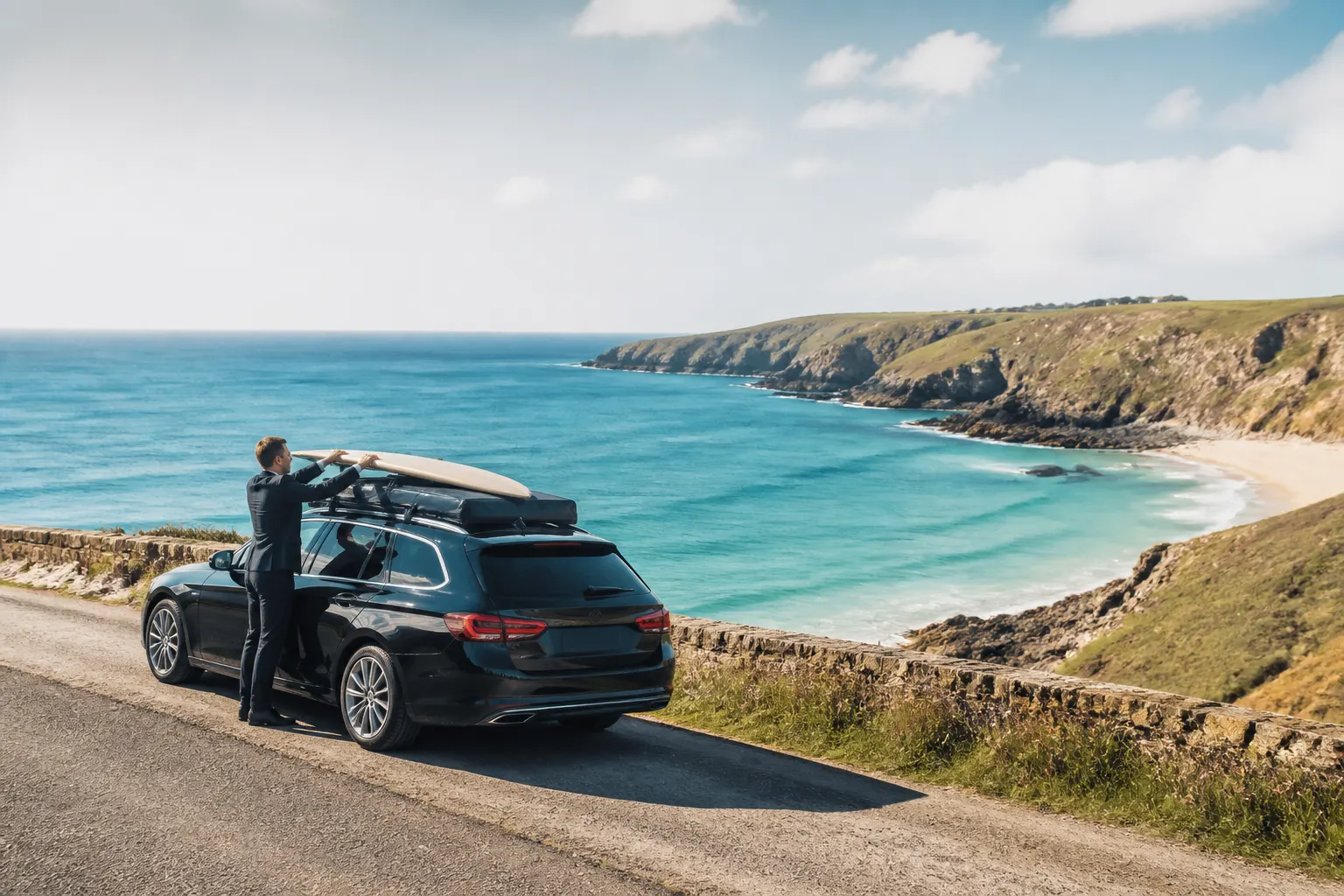


This pairing comes up whenever a group is travelling somewhere slightly awkward. Both vehicles are tall, both are comfortable, and both are frequently described as the practical choice, yet they solve almost opposite problems. One is built around interior volume; the other is built around going anywhere, in some style, with four people aboard. Choosing between them badly is easy and entirely avoidable.
The decision usually turns on two numbers and one road. How many people are travelling, how many cases they are carrying, and what the final stretch to the destination looks like. Get those three straight and the answer generally announces itself, though not always in the direction people expect when they picture the two vehicles side by side.
Volume against capability
The V-Class is essentially a well-appointed room on wheels. Its height and length go entirely into usable space: individual seats, a flat floor, sliding doors and a genuine luggage bay behind the back row. Nothing is sacrificed to styling, which is why it carries more than any comparably sized vehicle and why airport companies across Europe rely on it. Practicality is the whole design brief.
The Range Rover Autobiography spends its size differently. Some goes into a beautifully trimmed four-seat cabin, some into ground clearance, air suspension and a driveline that will cross a flooded lane without drama. It is a luxury vehicle that retains genuine capability, and that combination is the whole reason it exists. Every dimension it spends on capability is a dimension not spent on seats.
What each will actually carry
For six or seven passengers there is no contest, because only one of these vehicles has that many seats. The V-Class takes a full group with luggage behind them, and the loading is simple and repeatable. For a delegation, an extended family or a wedding party, this is the vehicle that removes the problem rather than dividing it. Nobody travels with a case on their knees.
With four passengers the comparison becomes real. The Range Rover will take four adults in considerable comfort and four large cases in a deep, square load bay with a split tailgate. That is a strong showing, and for a family of four it is entirely sufficient. Beyond four passengers, or with an unusual quantity of luggage, the people carrier pulls ahead again and keeps going.
The last mile and its surface
Where the destination has a proper road to the door, the people carrier is untroubled and its lower floor makes loading easier. Airports, hotels, city addresses and conference centres are all straightforward, and its unremarkable appearance is an advantage rather than a drawback at a busy forecourt. Where the destination has been designed for vehicles, the more capable one gains nothing at all, and the extra ground clearance simply makes the step in higher.
Where the last stretch is gravel, mud, a steep unmade drive, a flooded lane or a field being used as parking, the Range Rover is in a class of its own. Four-wheel drive, ground clearance and air suspension turn a genuinely difficult approach into an ordinary one. For shoots, country weddings, estates and rural houses in winter, that capability is not a luxury but the reason for the booking.
It is worth asking the venue directly about the approach before deciding. A great many country houses have a perfectly good tarmac drive and a people carrier will manage happily; a great many others have three hundred yards of rutted gravel and will not. The difference between those two drives is not visible on a map and matters enormously on the day.
Set against each other
The two vehicles rarely tie. On almost every practical criterion one of them is clearly the better instrument, which makes the choice easier than it first appears. The one line where they genuinely compete is comfort for four adults over a long motorway journey, and even there the surface at the far end usually settles it. Everything else falls one way or the other.
- Five or more passengers: the V-Class, since the seats simply exist
- Difficult surfaces, mud, gravel or snow: the Range Rover, decisively
- Total luggage volume: the V-Class, by a considerable margin
- Presence at a hotel or private entrance: the Range Rover
- Ease of entry for older passengers: the V-Class sliding door and flat floor
- Facing seats and working as a group: the V-Class where fitted
- Comfort for four on a long motorway run: close, with the Range Rover ahead
- Discretion on a residential street: both are unremarkable, the V-Class more so
When the people carrier is the wiser booking
Whenever the group is larger than four, the argument is over. There is no configuration in which a five-seat vehicle carries six people, and the alternative of two cars costs more, splits the party and doubles the coordination. Clients occasionally ask us to make the prestige option work anyway, and we would rather explain the seating than take the booking and disappoint them.
It also wins for airport work with a full luggage load. Duty free, coats, a pushchair, sports equipment and four checked bags fit into the rear of a people carrier with room to spare. The Range Rover copes with four cases and stops being comfortable soon after, and nobody wants to discover the ceiling of that at a terminal at dawn.
And it wins for anyone with mobility difficulties. A sliding door needs no swing space in a tight street, the floor is flat, the step is low and there is room to move about inside. For an elderly passenger, or for a group where somebody uses a folding chair, that is worth more than any amount of kerb appeal. It is the kind of detail that decides a booking.
How we would advise on the day
Tell us the destination in full rather than the town, particularly if it is rural. A postcode and a venue name let us look at the approach and say honestly whether a lower vehicle will manage it. Then tell us the passenger and case count, since that is what decides everything else, and whether anybody in the party needs help getting in.
Vehicles come from our own cars and from a vetted network of professional chauffeur operators, so we quote a class of vehicle rather than a specific one, with model year, colour and interior specification subject to availability. Send the outline on WhatsApp or by email and we will recommend one of the two, or occasionally suggest that the right answer is a different vehicle altogether.