





A taxi and a chauffeur car both end with you being driven somewhere by somebody else, which is roughly where the similarity stops. They are licensed differently, booked differently, charged on different principles and staffed by people trained for different work. Neither is superior in the abstract. The useful question is which of the two suits the journey in front of you, and that answer moves with the hour, the luggage and the occasion.
What follows sets out the genuine distinctions, in the order they tend to matter: the licence, the way work is allocated, the waiting, the vehicle and the manner of the person at the wheel. It also states plainly where a taxi is the faster and more sensible choice, because there are a great many British journeys on which it is, and pretending otherwise would be no use to anybody reading.
Two licences, two ways of working
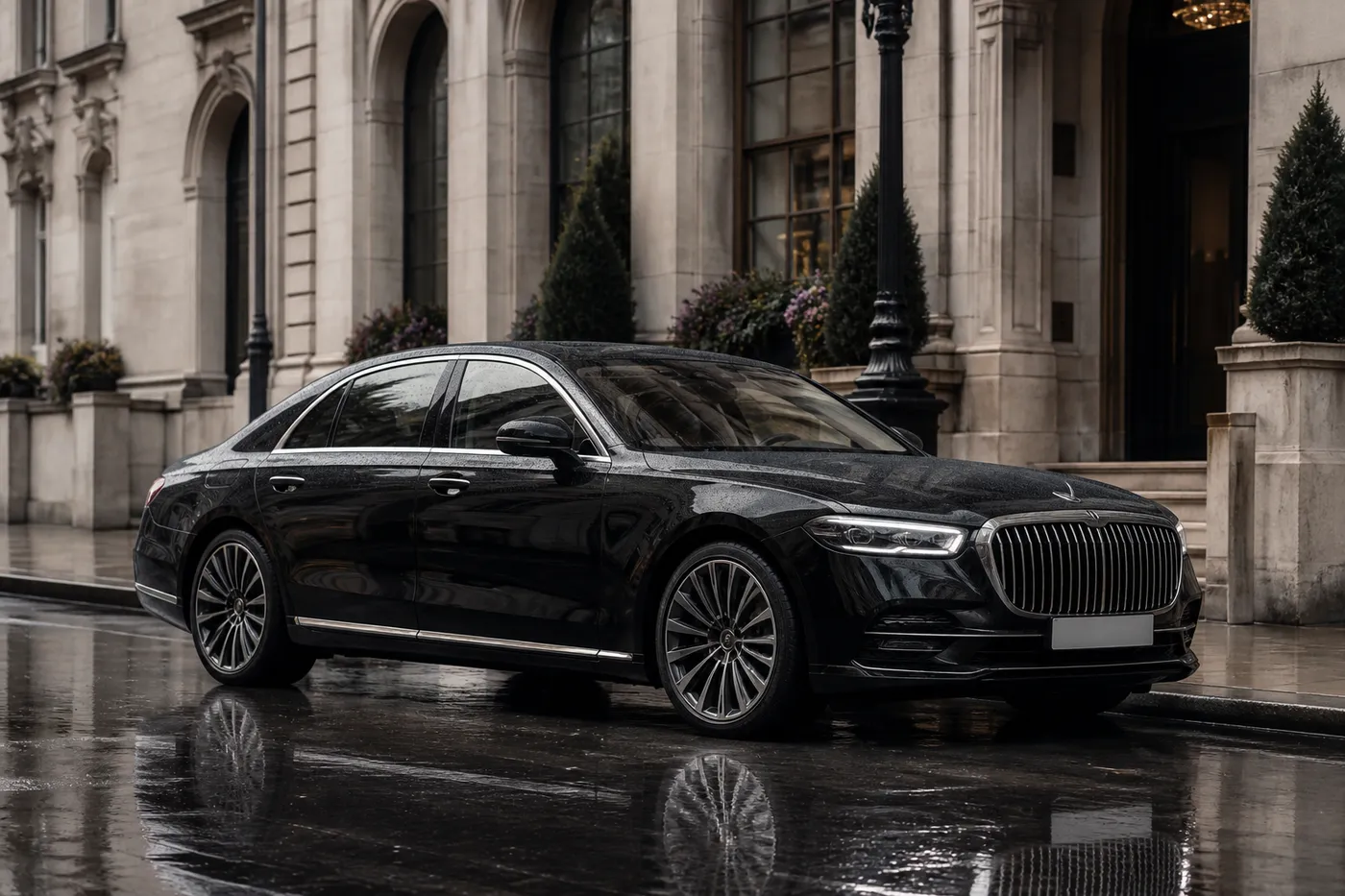
Licensed passenger vehicles in the United Kingdom fall broadly into two families. Hackney carriages, the black cabs of London and their equivalents elsewhere, may be hailed in the street or taken from a rank, and their fares run on a meter set by the local licensing authority. Private hire vehicles, a category that includes every chauffeur car, may not be hailed at all. They must be booked through a licensed operator, and the journey is agreed before it begins.
That single legal distinction produces almost everything else. Because a chauffeur car cannot accept a passing fare, it is dispatched to one booking at a time and held for it. Because a taxi can, it works a shift and flows continuously towards whoever is nearest. Both models are properly regulated and both are legitimate. They simply optimise for different things: immediate availability on one side, prior certainty on the other.
Hailing, ranks and booking ahead
The great virtue of a taxi is that it exists now. Step out of a building on a main road in any large British city and one will usually appear within a few minutes, with no arrangement, no application and nothing settled in advance. For an unplanned journey that is close to unbeatable, and a chauffeur company that claims otherwise is selling rather than advising.
A chauffeur booking works from the opposite end of the problem. The vehicle class, the timings and a named professional chauffeur are settled days or weeks ahead, quoted in writing, and then held for you whether or not your morning runs to plan. Nothing is allocated at the moment you need it. Spontaneity is the price; the return is that a five o'clock collection on a wet January morning is no longer a matter of hope.

Waiting, and who absorbs the delay
Waiting is where the two diverge most sharply, and where most of the value sits. A meter runs while a taxi stands still, so a driver who has spent an hour outside an arrivals hall has lost most of a morning's earnings. The economics do not encourage patience and were never designed to. That is a feature of the trade rather than a fault in it.
A chauffeur booking treats waiting as part of the work rather than an interruption to it. If a meeting overruns, if immigration is slow, if a hospital appointment runs long, the car is still there and the arrangement does not change shape. For an airport arrival in particular that is the entire case for the service: somebody is standing in the terminal regardless of what the baggage belt decides to do.
Point by point, without romance
Stripped of the marketing on both sides, the comparison reduces to a short list of practical differences. Read them against your own day rather than in the abstract: the same route can favour either option depending on nothing more than the hour it happens, whether you are carrying cases, and whether anybody needs to be waiting for you at the far end.
- Availability: a taxi is there now; a chauffeur car is there because you booked it
- Charging: taxis run on a meter, chauffeur journeys are quoted in writing beforehand
- Waiting: built into a chauffeur booking, costly on a running meter
- Vehicle: a taxi is whatever arrives, a chauffeur car is agreed in advance
- Luggage: black cabs take more than people expect, though only in the cabin
- Continuity: one chauffeur across a whole day, several taxis for the same day
- Discretion: an unmarked car draws no attention at a house or an office
When a taxi is the better choice
For a short single hop with no luggage and no deadline, take the taxi. Green Park to Soho on a quiet afternoon, a hotel to a restaurant half a mile away, a dash across town because your plans changed twenty minutes ago: none of these is a chauffeur journey, and arranging one would add formality to something that needs none.
It wins again whenever the timing is genuinely unknowable. If you are leaving a long dinner with no idea whether it will finish at ten or at one, a booked car is either held for hours or booked for the wrong moment. Walking to a rank when you are actually ready is simpler, and in a city with a real hackney trade it is dependable.
There is also the matter of knowledge. In London above all, but in Edinburgh, Glasgow and central Manchester too, cab drivers hold the streets in their heads. A route improvised around a closed junction at half past five is frequently better than anything a screen would offer. That expertise deserves respect rather than dismissal, and it is not something a booking system can replicate.
Deciding, and how a booking is made
The test we apply is straightforward: does anyone need to be waiting? If the answer is yes, because a flight is landing, a train is arriving from the north, a meeting may overrun or a parent is being discharged from hospital, a chauffeur booking earns its place. If the answer is no and the journey is short and immediate, the taxi is the better instrument for the job and we will tell you so.
Where a booking does make sense, it begins with an outline: the date, the addresses, the number of passengers and the number of large cases. We reply with a written quotation covering the class of vehicle, the timings and the terms, and nothing is confirmed until you have agreed it. Everything is arranged over WhatsApp or by email, with one person handling the enquiry from beginning to end.