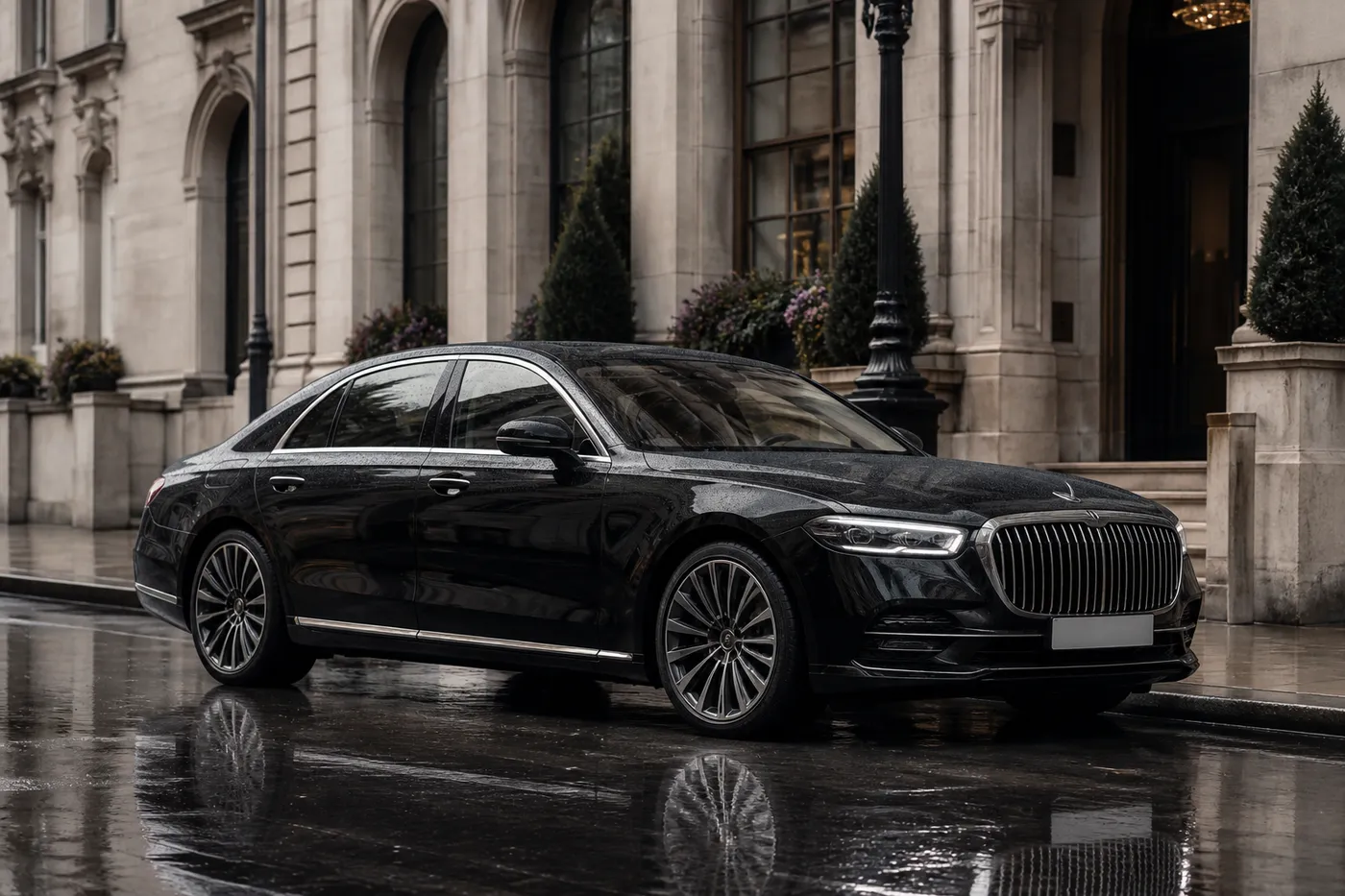


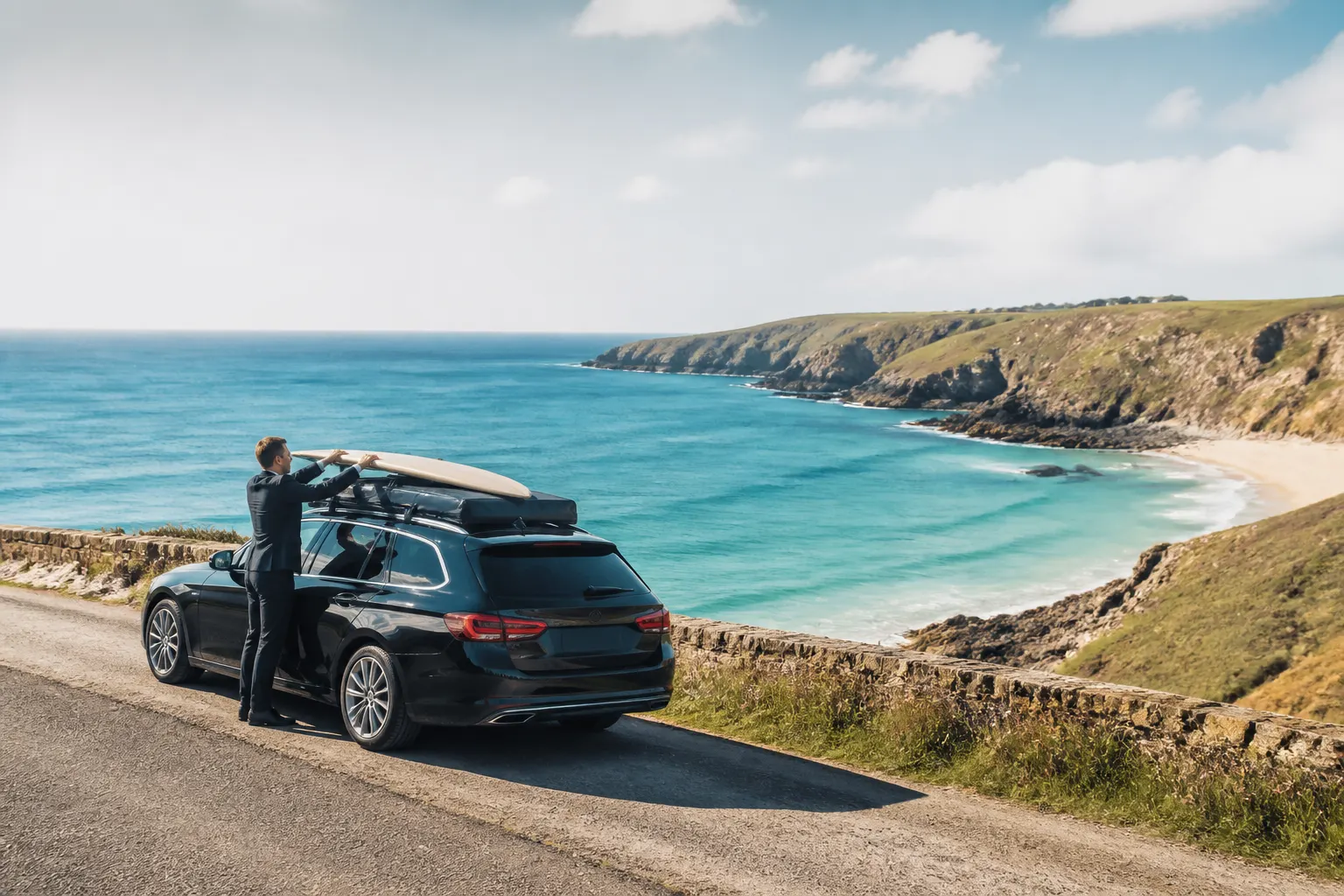


Britain's long-distance road network is small, old and heavily used, and it concentrates an enormous amount of traffic onto a handful of routes. Once you know where those routes reliably fail, planning a cross-country journey becomes a matter of arithmetic rather than optimism. Once you also know which journeys the railway does better, the arithmetic gets easier still.
This is a candid look at what a long chauffeured journey between British cities actually involves: how the spine roads behave, where the delays live, how long the common pairs really take, and the cases where we would advise the train with a car at each end instead. Nothing here is intended to sell a longer journey than you need.
The spine and how it behaves
The M1 runs from London to Leeds, the M6 continues north west from the Midlands to Carlisle, and the M74 carries on into Scotland. The M4 goes west to Bristol and South Wales, the M5 south west towards Exeter, the M40 north west to Birmingham, and the A1 and A1(M) form the eastern route to Newcastle and Edinburgh. The M25 connects all of them and absorbs the consequences.
Each has its own character. The M6 through the West Midlands is the busiest stretch of motorway in the country, with the M6 Toll offering a parallel route that is frequently much quieter. The M62 crosses the Pennines at height and is affected by weather more than any other trans-Pennine route. The M5 in summer carries holiday traffic to the south west on a scale that reshapes entire weekends.
The reliable trouble spots are worth naming. The M25 between the M4 and the M1 on the western side. The Catthorpe interchange where the M1 meets the M6. The A14 across Cambridgeshire. The M4 through the Brynglas tunnels into South Wales. The A303 past Stonehenge on a Friday in August. A chauffeur planning a long journey works around these rather than through them.
- The M25 western side between the M4 and the M1
- Catthorpe, where the M1 meets the M6
- The A14 across Cambridgeshire
- The Brynglas tunnels on the M4 into South Wales
- The M5 heading south west on summer Fridays
- The A303 past Stonehenge in the holiday periods
Honest timings for common journeys
Every duration below assumes reasonable conditions and includes no allowance for a serious incident, which is the one thing no plan survives. We quote with margin and we would rather arrive early than explain a delay from inside it. Where a journey has a hard deadline at the far end, we build the departure around that rather than the drive time.
It is also worth saying that a long road journey has a different quality when someone else is driving. Four hours on the M6 as a passenger is four hours of work, sleep, calls or conversation. The same four hours behind the wheel is four hours of driving, and you arrive in a different condition.
- London to Birmingham: commonly two and a half to three and a half hours
- London to Manchester: usually four to five hours
- London to Leeds: generally four to four and a half hours
- London to Bristol: commonly two and a half to three hours
- London to Edinburgh: usually eight to nine hours with breaks
- Manchester to Edinburgh: generally four to five hours
- Birmingham to Bristol: commonly around two hours
- London to the Cotswolds: usually two hours to two and a half
Breaks, driver hours and comfort
On any journey beyond about two and a half hours we plan a stop. Professional chauffeurs take breaks as a matter of discipline rather than convenience, and a well-chosen stop is a great deal more civilised than a motorway services chosen at random. Where a journey is long enough to warrant it, we can suggest a stop worth making rather than one merely available.
For very long journeys, or a long journey followed by a full day of engagements, there are limits to what one chauffeur should reasonably do. Where that applies we will say so at the quotation stage and propose an arrangement that works, whether that is an overnight positioning, a later start, or a second chauffeur.
Comfort in the car matters more over four hours than over forty minutes. Rear climate control, reclining seats and proper insulation are the difference between arriving rested and arriving stiff, which is why the vehicle recommendation for a long journey is usually different from the one for a city day.
When the train is the better answer
On the main lines, the railway is genuinely fast. London to Manchester, Leeds, York, Birmingham, Bristol, Newcastle and Edinburgh are all quicker by train than by road, often by a considerable margin, and the journey is usable time. For a single traveller with light luggage and a city centre destination, we will frequently recommend it.
The road wins where the railway is awkward: cross-country routes with changes, journeys to somewhere without a useful station, groups of three or more travelling together, heavy luggage, late evening returns and anything with several stops along the way. It also wins when the day is not really about arriving anywhere in particular.
The combination is often best of all. Rail for the long leg, a chauffeur at each end for the parts the railway cannot do. That is the arrangement we suggest most often for business travel, and it is worth asking about rather than assuming a single mode has to cover the whole journey.
Weather, seasons and the long view
Long journeys are the ones most affected by weather. The Pennine crossings, the Scottish routes and the higher stretches of the A66 and the A1 in Northumberland all suffer in snow, and high winds close certain bridges to some vehicle types. In winter we plan longer and start earlier as a matter of routine rather than as a reaction.
Seasonal traffic is equally predictable. The M5 south west on summer Fridays, the A303 in school holidays, the roads north on the Friday of a Scottish holiday weekend, and every motorway on the Thursday before Christmas. None of this is a surprise to anyone who drives for a living, and all of it should shape a departure time.
Where a journey is time critical, tell us at the enquiry stage. There is almost always an arrangement that removes the risk, whether that is travelling the previous evening, taking the train for the long leg, or simply starting two hours earlier than feels necessary.