




London operates more than one road charging scheme, and they do different things. One is about how many vehicles enter a defined central area at certain times. Another is about how clean those vehicles are, and applies over a much wider area. There are further arrangements for heavier vehicles and for particular crossings. Between them they have generated a great deal of confusion and a fair amount of anxiety among visitors.
The reassuring part is that almost none of it is your problem. Scheme rules are set by Transport for London and by individual boroughs, they are revised from time to time, and keeping up with them is part of what an operator does. This page explains what the schemes are for, how they shape a journey, and where they appear in a booking, which is in the written quotation and nowhere else.
Two different ideas, often confused
The congestion scheme is about volume. It applies to a defined area of central London during defined periods, and its purpose is to reduce the number of vehicles entering that area. The emissions scheme is about vehicle standards. It applies over a much wider area and asks whether a particular vehicle meets a specified emissions class, charging those that do not.
They are frequently spoken of as though they were the same thing. They are not, and a vehicle can be affected by one and not the other. There is also a separate low emission arrangement covering heavier goods vehicles, and charging on certain river crossings east of the city, which is a different matter again.
The areas, the periods, the vehicle classes and the exemptions are all set by the relevant authority and have all been changed since the schemes began. That is precisely why we confirm the position for your vehicle and your route at the time of booking rather than quoting anything from memory or from a page written last season.
What it means for your car
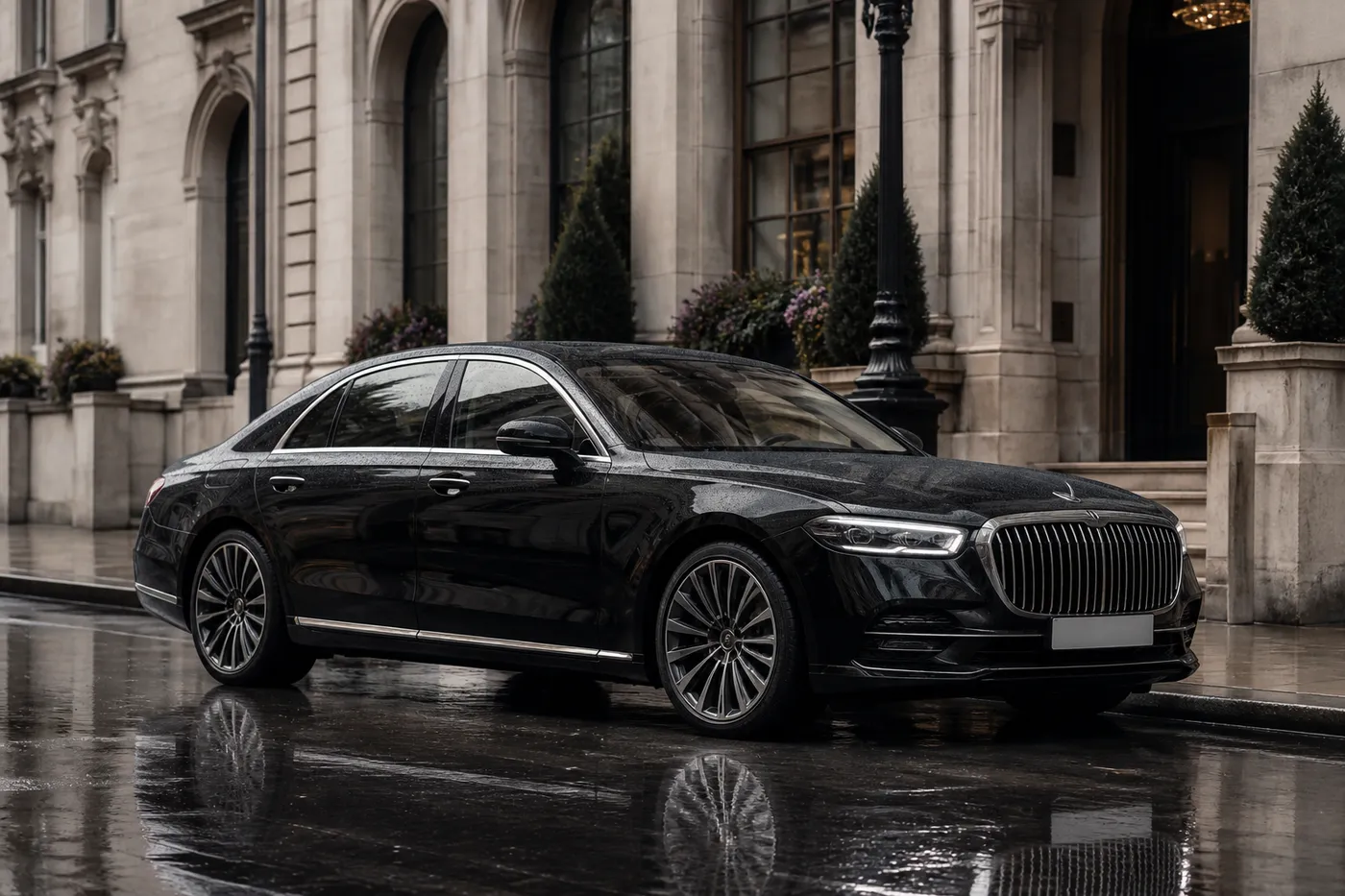
For a chauffeur operation, emissions requirements are a fleet question rather than a journey question. Vehicles used for work in London are chosen and maintained with the applicable standards in mind, and compliance is our responsibility. You are not asked to check anything, present anything or pay anything at the roadside.
Vehicles come from our own cars and from a vetted network of professional chauffeur operators, and the same expectation applies throughout that network. When we quote a London journey, the vehicle proposed is one that can lawfully make it. If a particular car cannot, we will offer a different one rather than a surprise.
Where a charge falls due on your journey, it forms part of the written quotation you agree before the booking is confirmed. There is no separate reckoning afterwards and no line item appearing later. That is the whole of the passenger experience of London road charging, and it is deliberately dull.
- Charging schemes are set by the authorities, not by operators
- Rules, areas and classes have been revised more than once
- Vehicle compliance is the operator's responsibility, not the passenger's
- Any applicable charge is included in the written quotation
- Nothing is ever collected from you at the roadside
- We confirm the current position for your vehicle and date at booking
Why your route sometimes looks indirect
Charging is only one of several reasons a London route takes an unexpected shape. Far more often the driver is avoiding a bus gate, a banned turn, a low traffic filter or a street that excludes private cars. The map shows a line; the road network shows a set of permissions, and the two are not the same document.
There are also occasions when the sensible route around the edge of the centre is faster as well as simpler. A journey from west London to the City can go straight through Marylebone and Holborn or around the northern side, and on a weekday afternoon the second is frequently quicker. A chauffeur will make that judgement without being asked.
If you would like to understand a particular routing, ask. There is always a reason, it is usually about time or permissions rather than charging, and the answer is generally more interesting than people expect. It is also worth knowing that a professional will not gamble on a restriction to save two minutes, because the consequence arrives weeks later as a notice rather than immediately as a delay.
- A bus gate or banned turn sitting on the direct line
- A street that excludes private cars entirely
- A low traffic filter removing through movement
- Roadworks or a closure announced at short notice
- A faster run around the edge rather than through the centre
- A set-down point on the correct side of the street
Coming in from outside London
For journeys arriving from elsewhere in the country, charging schemes matter mainly at the point where the journey enters the affected area. A transfer from Heathrow to Mayfair, a run down from Birmingham or a drive from Kent will all cross into scheme areas at some point, and the quotation accounts for that.
The Dartford crossings east of London operate their own charging arrangement, which is separate again and applies to a specific route rather than an area. Where a journey uses that crossing it is included in the quotation in the same way. We would rather set all of this out once, in writing, than have it emerge in stages.
For visitors driving themselves, the picture is different and considerably more demanding, since payment obligations fall on the driver and deadlines apply. That is one of the quieter arguments for a chauffeur on a London visit: the administrative burden simply does not reach you. On a short trip with a full diary that is often worth more than the comfort of the car, and it removes an entire category of thing to remember on the way home.
Practical advice for a London visit
The useful thing you can do is tell us the shape of the day when you enquire. Which areas you need to reach, at what times, and whether anything has a hard deadline. From that we can advise on routing, timing and vehicle, and the charging position follows automatically rather than being a separate conversation.
It is also worth knowing that charging is rarely the deciding factor in whether a chauffeur makes sense for a given journey. Waiting time, luggage, multiple stops and evening availability matter far more. For a single short hop across the centre at an off-peak hour, we will often say a taxi is the better answer, and that advice has nothing to do with any scheme.
Everything is arranged by WhatsApp or email. Send the outline, receive a written quotation covering the vehicle, the timings, the terms and any applicable charges, and nothing is confirmed until you have agreed it. If the charging position changes between booking and travel, we will tell you rather than adjusting the arrangement quietly, which has been worth doing more than once since the schemes began.