





Accessibility is usually presented as a yes or no question, which is why so many people receive answers that turn out to be wrong at the kerb. In reality it is a set of specific problems: getting through a door aperture, lowering into or rising from a seat, stowing a folded chair, or boarding without leaving a wheelchair at all. Each has a different solution and a different vehicle.
What follows explains the measurements that actually decide whether a car works for a passenger, what separates a standard chauffeur vehicle from a wheelchair accessible one, and how to describe a requirement so that a supplier can answer honestly. It ends with our own position, which includes being straightforward about the requests we cannot always meet.
Accessibility is a spectrum, not a box
Consider the range in one family. A passenger who walks slowly and needs a moment with a grab handle is well served by almost any executive saloon. Somebody who cannot bend easily needs a higher hip point and a wider door, which points towards a large MPV rather than a low, sporting saloon. A passenger who transfers from a wheelchair into a seat needs both a suitable seat height and somewhere sensible to put the chair.
A passenger who remains in their wheelchair for the journey needs a different category of vehicle altogether. Those four cases are frequently described with the same word, and a supplier who hears accessible and pictures only the last one, or only the first, will send the wrong car. Describing the actual difficulty rather than using the umbrella term is the single most useful thing a booker can do.
The measurements that decide it
Three dimensions do most of the work. Door aperture height and width determine whether somebody can enter without stooping awkwardly. Seat height relative to the ground determines whether a passenger lowers into the car or rises into it, and rising is usually easier for people with hip or knee difficulty. Sill width determines how far somebody has to reach across before they are seated at all.
Boot dimensions decide the equipment question. A folded manual wheelchair, a rollator or a mobility scooter each need a specific space, and a boot that swallows three suitcases may still be the wrong shape for a rigid frame. Measure the folded item once, write the figures down, and give them when booking. Those numbers settle in one message a question that otherwise takes three exchanges of adjectives.

Wheelchair accessible vehicles explained
A wheelchair accessible vehicle, usually shortened to WAV, is a purpose-converted vehicle with a ramp or lift and a floor-level restraint system, allowing a passenger to board and travel while remaining in their chair. It is a specific conversion with specific equipment, and the driver needs to know how to secure a chair properly, which is a practical skill rather than an assumption.
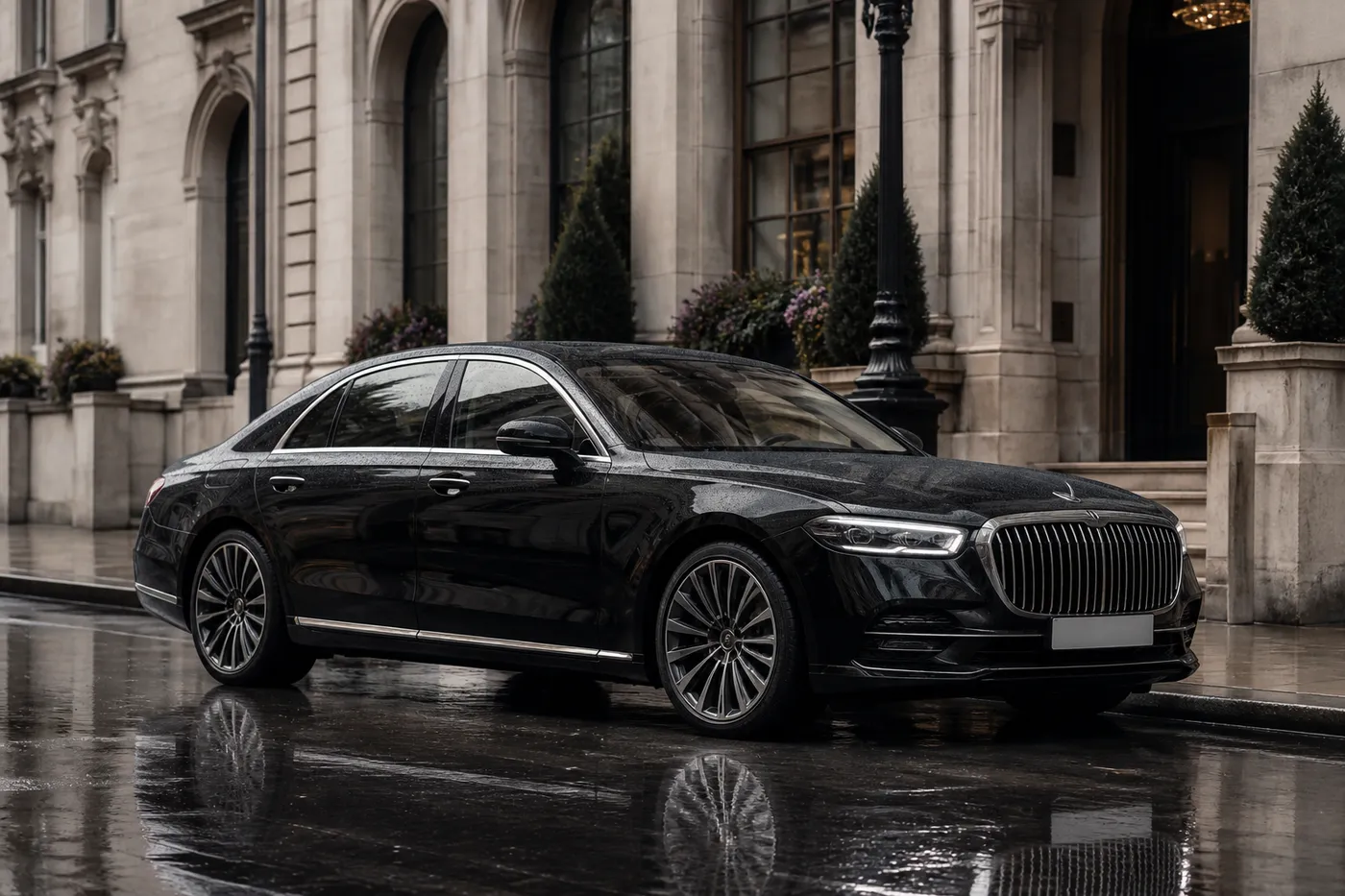
It is important to be plain about the consequence. Conventional chauffeur vehicles, including executive saloons, flagship saloons and luxury people carriers, are not wheelchair accessible vehicles. They can carry a folded chair and a passenger who transfers into a seat, and they cannot carry a passenger who stays in their chair. Where a WAV is genuinely required, it needs arranging as a WAV, and licensed taxis are often the more available answer in many towns.
Assistance dogs and other requirements
Assistance dogs travel with their handler, and the expectation across UK licensed transport is that they are carried without fuss, question or additional charge. Tell your supplier anyway, not because permission is needed but because it affects which vehicle is sensible and how the footwell is arranged. Good practice is a simple acknowledgement in the booking confirmation so nobody has a conversation about it at the kerb.
Other requirements are worth naming just as directly: a passenger who needs the car kept warm, one who cannot manage a long walk from a set-down point, one who needs the chauffeur to come into a reception rather than wait outside, one travelling with oxygen or medical equipment. None of it is unusual. All of it changes how a collection is arranged, and none of it can be planned for if it is not mentioned.
Questions to ask any supplier
Accessibility answers are only useful when they are specific. The questions below push a supplier towards facts about a particular vehicle on a particular date, rather than a general reassurance about a fleet that may well contain one suitable car and several that are not. Ask them before you commit to anything, and give your own measurements alongside. A precise question tends to earn a precise reply.
The final question is the one that matters most. A supplier willing to say no has told you that its yes means something, whereas a company that says yes to everything will eventually say yes to something it cannot actually do, and that discovery tends to happen on a pavement rather than in an email exchange. Ask it last, and listen carefully to the answer.
- Which exact vehicle would you send, and what is its seat height?
- Can you carry a folded chair of these dimensions in the boot?
- Is this a wheelchair accessible vehicle, or a car with a large boot?
- Will the chauffeur assist with a transfer, and how far will they walk?
- Can the car reach the door of the building, or only a car park?
- Are assistance dogs carried without question?
- If you cannot meet this requirement, will you say so plainly?
How we answer an accessibility request
We ask questions before we answer. What the difficulty actually is, whether the passenger transfers or remains seated in a chair, the folded dimensions of any equipment, how far the walk is at each end, and whether somebody is travelling with them. Only then do we say which vehicle suits, because a recommendation made without those answers is a guess dressed up as a service.
Where a request is outside what we can arrange for a date, we say so directly and, where we can, point you towards the kind of provider who can. Our cars and those of the vetted professional chauffeur operators we work with are conventional executive vehicles rather than converted ones, and we would far rather tell you that early than have somebody discover it beside a car that does not work for them.